In about 1986, the Government of the Philippines established a Debt-to-Equity Program with a view to encouraging foreign and Filipino investors to invest in Philippine enterprises and reduce the country's external debt burden. Investors with external debt obligations (held by commercial banks or financial institutions) who were redeemed or paid in pesos could invest the peso proceeds in the shares of Philippine enterprises. The Program contained incentives for investors, including more liberal terms on repatriation and remittance of investment earnings, and targeted investments in preferred sectors or areas, especially those requiring prompt economic revitalization and foreign exchange earning industries.
Over the years, a number of international investment vehicles were
established to invest in the Program, including a Long Term Equity Fund (the
"Fund") in Bermuda in about 1988. John Collis was appointed as a director of the
Fund at the time of incorporation. In addition to Mr Collis, the board of
directors of the Fund was made up of three or so directors affiliated with the
UK investment manager of the Fund and two directors from the Philippines, one of
whom was a representative of, or had connections with, the Philippines
Department of Finance. In addition to the UK investment manager, there was a
Philippines investment manager with particular expertise in Philippines
investments and a number of their senior executives participated in Board
meetings.
Regular board meetings of the Fund were held in Manila. Mr Collis made his
first visit to Manila in November, 1988 and thereafter visited Manila twice a
year until about 1996. In addition to attending to the typical business of the
Fund, the Board made many visits to actual and potential investee companies
across the country. As such, the directors worked together quite a lot and got
to know one another well.
The Fund became fully invested in about 1996. Eventually, all the investments
were sold and the Fund closed in about 2005.
Because of the close working relationships at the Board, Mr Collis got to know the Filipino participants in the Fund well. In discussions outside of board meetings, for instance while travelling the country or at dinners, Mr Collis and the Filipino participants discussed many matters of general interest concerning the Philippines and Bermuda, including the growing Filipino community in Bermuda and the interest of the Philippines Government in ensuring the well-being of Filipinos working abroad.
At some point, the Filipino participants, including the participant with
close connections to the Department of Finance, asked Mr Collis whether he would
be prepared to act as an Honorary Consul of the Philippines in Bermuda. The role
was to be "honorary" and information-related, agreeing to keep a lookout for any
unfair treatment of Filipinos in Bermuda and reporting back to the authorities
in Manila. Mr Collis happily agreed.
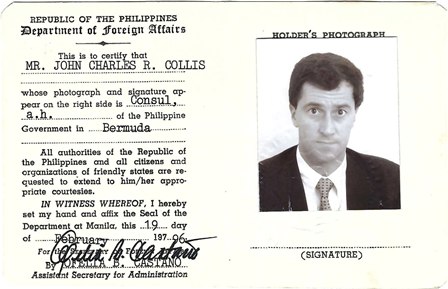
After completion of the formalities in the Philippines, Mr Collis was
formally appointed to the role of Honorary Consul on 19 February, 1996.
During his time as the Honorary Consul, Mr Collis attended a number of events
of the Filipino community in Bermuda. While he had no power to issue visas or
other official documents on behalf of the Philippines Government, he would
certify documents for Filipinos looking to make official applications in the
Philippines. He also attended Bermuda Government functions for representatives
of foreign nationals in Bermuda to ensure that the Bermuda Government was
conscious and aware of the Filipino community.
At some point in the early 2000s, Mr Collis visited the Philippines Embassy
in London to report on matters in Bermuda.
As the Filipino community grew in Bermuda, and partly because Mr Collis had
kept the Philippines Government informed of its existence, it was decided by the
Philippines Government to put in place a more permanent and robust consular
connection between Filipinos in Bermuda and the Philippines. Accordingly, Mr
Collis resigned as Honorary Consul in the [mid-2000s].
** Due to the significant passage of time and the fact that many of the relevant documents have been destroyed in accordance with institutions' retention policies, many of the dates and events referred to in this document are best guesses.
 Because of the close working relationships at the Board, Mr Collis got to know the Filipino participants in the Fund well. In discussions outside of board meetings, for instance while travelling the country or at dinners, Mr Collis and the Filipino participants discussed many matters of general interest concerning the Philippines and Bermuda, including the growing Filipino community in Bermuda and the interest of the Philippines Government in ensuring the well-being of Filipinos working abroad.